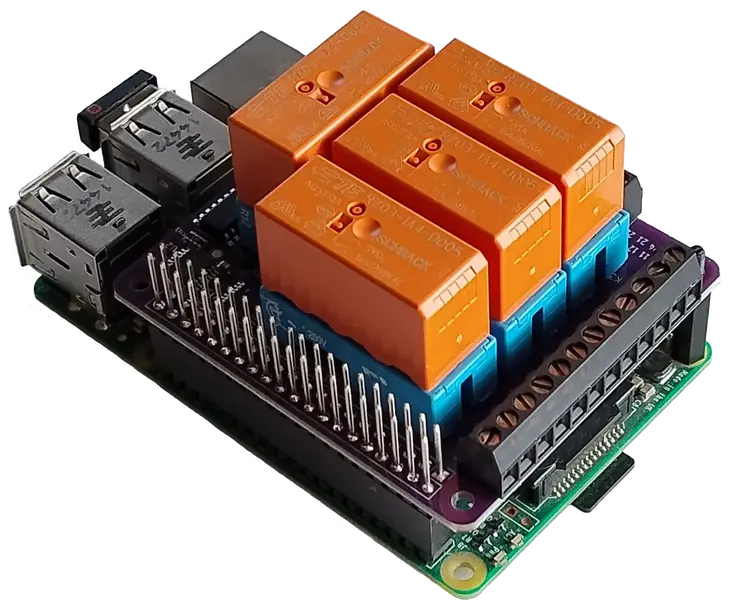
qReCon Flex: Raspberry Pi HAT with Variable & Replaceable Relay Type
Maximum versatility for your custom switching needs. A professional 4-channel socketed relay board designed for interchangeable relays and total control flexibility.
Built for Developers & Industrial Systems - Developer-Centric Hardware (DCH).
Replaceable Relay Sockets: Modular design supporting interchangeable relays from various manufacturers to fit your exact current, voltage, or load requirements.
Electrical Isolation: Optical isolation to safeguard logic circuits and your Raspberry Pi from power surges and noise.
Hardware-Deterministic: Physical DIP-switch for 2-mode GPIO pin selection and Active High / Active Low control.
Zero-Configuration Integration: Built-in Home Assistant Auto-MQTT Discovery for instant setup.
 Learn About Our Approach
The Objective Behind qRecon Flex
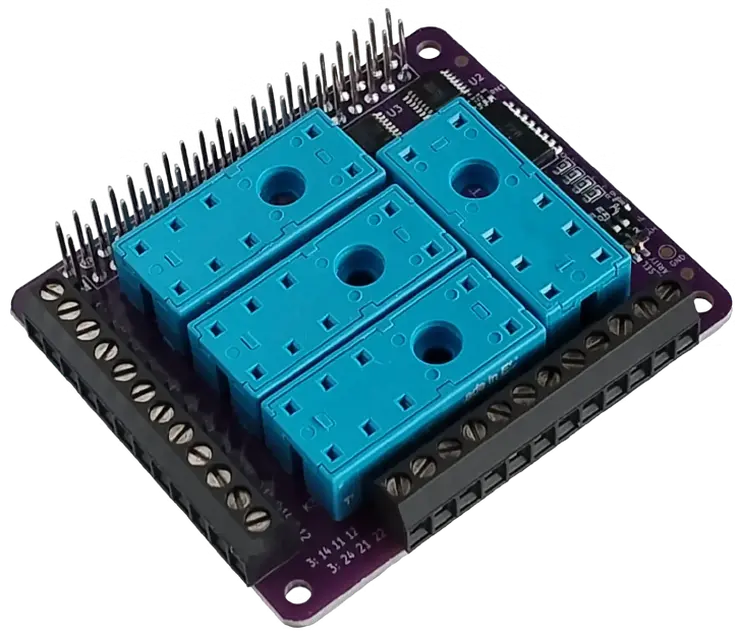
Driven by our Developer-Centric Hardware (DCH) philosophy, we set out to create a 4-channel relay module that breaks free from fixed relay limitations without compromising on electrical safety.
Generic relay boards force you into fixed current limits, lack proper optical isolation, and complicate software setup. By introducing replaceable relay sockets, complete optocoupler isolation, a DIP-switch selectable GPIO bank, and built-in Home Assistant Auto-MQTT Discovery, we built the ultimate modular control solution. Whether you need custom relay types for specific AC/DC loads or seamless smart home onboarding, you get maximum hardware flexibility with zero code configuration.
Design Choices for qRecon Flex
Endless Customization.
Compatible with a wide range of relay types and manufacturers for ultimate flexibility.
Built for Longevity
Relays are easily replaceable, ensuring your module outlasts other fixed-relay solutions.
Configurable Control Logic
Easily switch between Active High and Active Low with a simple jumper setting.
Flexible GPIO Selection
Choose between two GPIO groups to best fit your project and avoid conflicts with other add-on boards.
From Factor
For easy assembly, qUPS has HAT form factor. Simply connect it via the 40 pin header.
Stackability
Pins on the connector are long ones, all can be accessed from the top of the product.
Reliable Connection
Massive, soldered pin header for power and signal connection. Pogo pins are not reliable.
GPIO Communication
Easy programming. Avoid extra load on capacitance limited I2C bus. 4 GPIO ports for communication.
Optical Isolation
Optically isolated channels safeguard your Raspberry Pi from electrical noise and damage.
Zero Firmware
Everything is done by hardware.
qRecon Flex - Compatible Relays
The compatible 5V DC relays fit one of the two dimensional specifications detailed below, which include front, side, and footprint measurements. All units are in mm:
SPDT/DPDT type relays
Bottom view
SPST/DPST type relays
Bottom view
Examples of Compatible Relay Models
Omron
G2RL-1A-E(-ASI, -HA, -PW1) DC5 (SPST/16A)
G2RL-1-E(-ASI, -HA, -PW1) DC5 (SPDT/16A)
G2RL-1A-E-CV(-HA) DC5 (SPST/16A)
G2RL-2A(-HA, -PW1) DC5 (DPST/8A)
G2RL-2(-ASI, -HA, -PW1) DC5 (DPDT/8A)
G2RL-1A4-E DC5 (SPST/16A)
G2RL-14-E DC5 (SPDT/16A)
G5RL-1A-E(-LN, -HR, -TV8) DC5 (SPST/16A)
G5RL-1-E DC5 (SPDT/16A)
G5RL-1-E-HR DC5 (SPDT/16A)
Finder
40.51.9.005.xxxx (SPDT/10A)
40.52.9.005.xxxx (DPDT/8A)
40.61.9.005.xxxx (SPDT/16A)
TE Connectivity / Schrack
RT314005F (SPDT/16A)
RT42x005x (DPDT/8A)
RTD14005F (SPDT/16A)
RTE2x005x (DPDT/8A)
RTSxx005x (SPST/16A)
RZx3-1Ax-D005x (SPST/16A)
RZx3-1Cx-D005x (SPDT/16A)
Pin allocation of the qRecon Flex
GPIOSEL=ON
Relay 4/06
Relay 3/13
Relay 2/19
Relay 1/26
GPIOSEL=OFF
Relay 4/05
Relay 3/16
Relay 2/20
Relay 1/21
qRecon Flex User Interface and Indicators
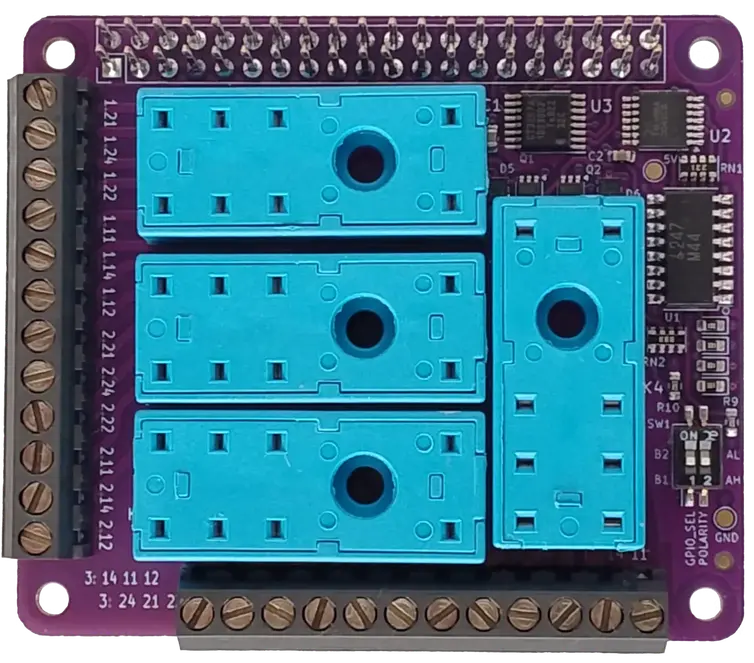
1 - Raspberry Pi 2x20 pin connector
2 - Relay sockets
3 - DIP Switch: setup GPIO ports, Active level (H/L)
4 - Relay 3 & 4 output connector
5 - Relay 1 & 2 output connector
Technical Specs of the qRecon Flex
Physical parameters
- Form factor
- Raspberry Pi HAT
- Dimensions
- 65x56x12 mm + 11mm header + Relay
- Stackable
Outputs
- Number of outputs
- 4
- Output type
- Relay
- Relay type
- Depend
- Max AC voltage
- Depend
- Max DC voltage
- Depend
- Max NO current
- Depend
- Max NC current
- Depend
Connectors
- Connection type
- Terminal block
- Vibration resistant
Communication
- Method
- GPIO ports
- Used GPIO ports
- 4
- GPIO groups
- 2 options
Safety
- Optical isolation
Software
- Control software
- C++ & Python
- Open Source
- Home Assistant compatibility
- Auto-MQTT Discrovery
qReCon Flex Home Assistant Integration
Home Assistant integration steps:
Communication setup:
Set the DIP switch on the qReCon for choosing the used GPIO ports
Active H/L setup:
Set the DIP switch on the qReCon for choosing the Active Level (High or Low)
Open the Github page:
https://github.com/aqexhu/synapse/tree/main/src
Download the driver and sample file:
qpio-ha & sample-config-flex.json
Update the MQTT parameters and GPIO Bank (dip) setup in the json file:
broker, port, username, password, dip_bank_select
Rename the json file, if you want
Start the driver
qRecon Flex Gallery